Flat / Publish from Claude
Publish your Claude artifact as a web page.
Export your Claude artifact as standalone HTML, upload the finished files to Flat below, and choose "Publish page". Flat gives you a link to the report or dashboard that your reader can open outside Claude.
Checking your upload limits... · Public · Limits
Drop your exported Claude files here
or choose the files you downloaded.
Select exported filesRecipients can open public links without a Flat account.
Create an artifact that can run on its own.
Ask Claude for a finished report, a browser dashboard, or a static prototype. Include the context your reader needs, such as the data period and what they should review.
A prompt for portable HTML
Create a standalone HTML report from this material. Include the CSS, browser JavaScript, and chart data. Make it work on phones and without Claude APIs, artifact storage, connected apps, or a backend. Label sample data and include source notes. Export the finished page as index.html.
Check the facts and calculations in the result. Ask Claude to include any separate assets and downloadable source data in the export.
Export the finished files from Claude.
For a design artifact
Open the artifact and choose "Export". Claude's design exports include standalone HTML and ZIP files. Choose HTML for a single page, or extract the ZIP and inspect its contents before publishing.
Export options depend on the artifact type. Docs can export to PDF, Word, or Markdown; decks can export to PowerPoint or PDF. If your dashboard has no standalone HTML export, ask Claude to create a self-contained HTML version as a downloadable file.
For a legacy artifact or local project
Legacy artifacts have controls at the top of the artifact panel to view code, copy content, or download it. If you copy complete HTML, save it in a plain-text file named index.html.
In Claude Code, use the finished files in your workspace. If the project needs a build, have Claude run it and publish the static output folder. Downloaded React source alone is not a built website.
A report that works outside the chat.
The published report shown here has an interactive chart and a CSV download. Readers can switch between units and revenue, then check the source data.
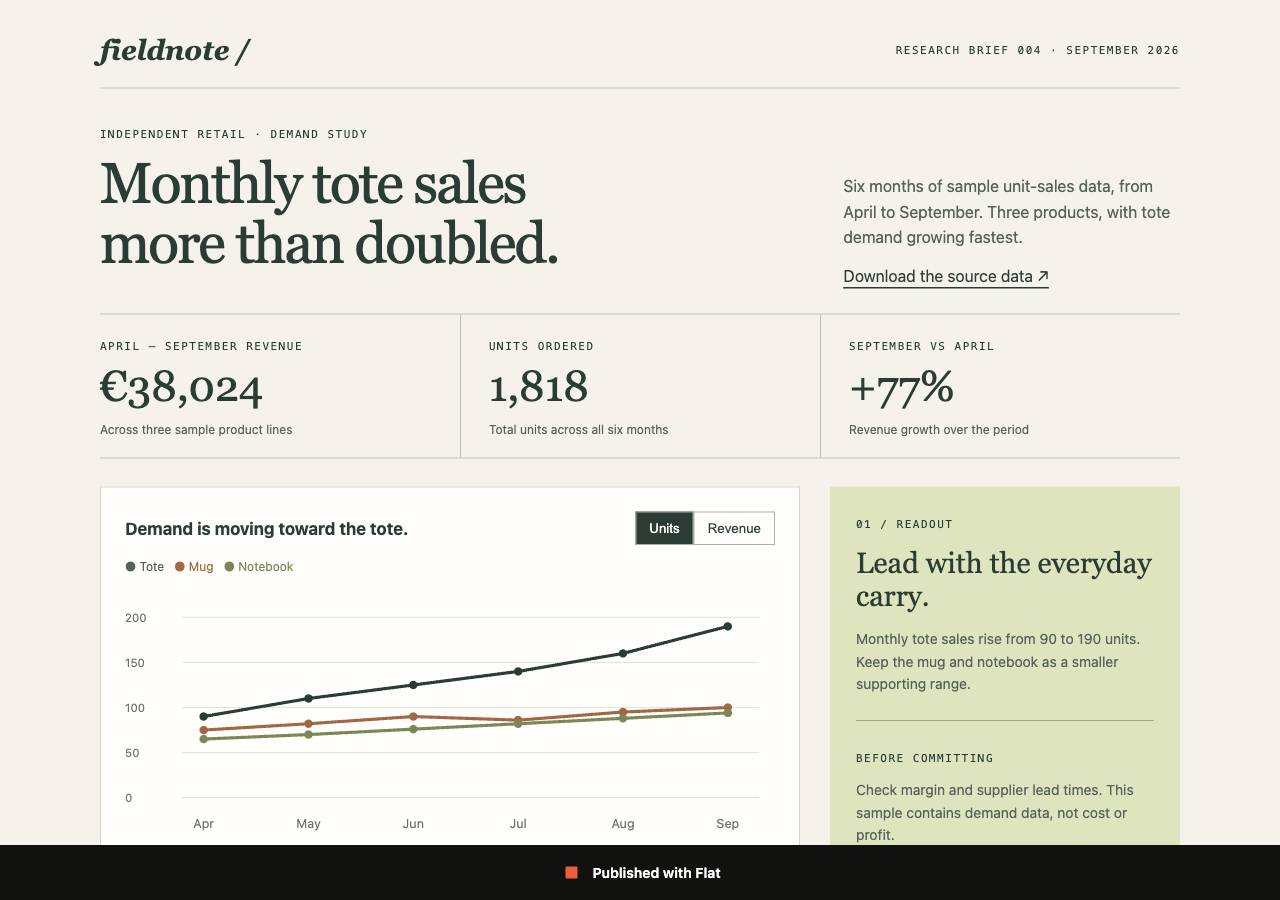
Upload the files, then check the link.
Prepare the main page
Name your main page index.html so it opens at the root link. Include any images, scripts, or downloadable data at the paths used in the HTML. Open the downloaded page in your browser before uploading.
If the export contains source code that needs a build, build it first. A React component or a folder containing package.json is not a finished static site.
Publish in your browser
Select index.html and its supporting files in the uploader above. Enter your email if signed out, then choose "Publish page" to get the link. Browser uploads place all selected files at the top level. Each file needs a unique name.
Browser uploads start public. For private work, set a password before publication through MCP, the CLI, or the API. Signed-out browser uploads expire after one hour. Sign in before uploading work you want to keep.
For nested folders, use the CLI or local MCP to preserve paths. Extract ZIP exports first. The browser uploader does not extract them.
npx -y @getflat/cli deploy ./finished-reportThis command needs Node.js 20 or newer. Replace ./finished-report with your extracted folder or ./index.html for one file.
Inspect the published result
Open the returned URL in a private browser window. Check the text, images, chart controls, and downloads. Try it on a narrow screen. Send the link once the result works without your chat session.
A file named report.html opens at /report.html. Without a root index.html, the main link opens Flat's file viewer or explorer. See HTML hosting and file paths.
Publish from a compatible Claude MCP client.
Follow Flat's MCP connection instructions to choose hosted or local MCP and check protocol support. Sign in before publishing work you want to keep.
Files on your computer
Local MCP can read a file or folder on the same computer. Once connected, ask your agent to publish the finished output folder with Flat and return its URL. This fits a Claude Code workspace or files you have downloaded locally.
Files in a remote session
Hosted MCP needs independently downloadable HTTPS source URLs, or a client that can upload the file bytes using Flat's prepare and finalize flow. A private artifact link or a local path in Claude's remote session does not transfer the file.
If the client cannot supply either transfer method, download the files and use the uploader above. See MCP file-transfer requirements.
After publication, open the returned URL yourself. Check the page and its controls before sharing it.
Publish the finished page and its browser code.
HTML, CSS, and browser JavaScript can run on Flat. A dashboard with embedded data can keep its charts and filters. Its data stays at the exported version until you create and publish a new one.
Flat does not run Python, Node.js servers, databases, or the AI tool's private runtime. A working preview inside the tool does not prove its download will work elsewhere.
Keep secret API keys, database passwords, and private tokens out of published files. Features that need credentials must call a separate backend that keeps those credentials on the server. Browser-accessible services also need suitable authentication and cross-origin settings.
For a report people only need to read, export a PDF and use PDF hosting. For interactive output, check the exported files against the HTML publishing guide.
Share the version you want reviewed.
A client can open your report before a call. A teammate can click through a static prototype without opening your Claude conversation. Send the link with the feedback you need.
See sharing AI-generated work and website and prototype previews for these handoffs.
Publishing from Claude
Can every Claude artifact run on Flat?
No. Exported static HTML and browser JavaScript can run. Features that call Claude, use artifact storage, or depend on connected apps do not carry over automatically. Ask for a standalone version or keep those features in their supported environment.
Is this the same as publishing inside Claude?
Claude's sharing controls publish through Claude. This workflow exports files and hosts them on Flat. The shared page runs from those files, with any external services you have configured separately.
Can I use my own domain and update the page?
Yes. Set up a named link or connect your own domain, then publish to it through MCP, the CLI, or the API. Export or build each revision from Claude, then publish to that same address. The browser uploader creates a new version link each time.
Who can open the link?
Browser uploads start public. Anyone with the link can open them without a Flat account. You can add a password in the upload's Settings in your dashboard. To protect files from the moment they go online, set a password when publishing through MCP, the CLI, or the API. Recipients who have access can still download or forward copies. Set up password protection.
Can I replace files at the same address?
Yes. Publish through MCP, the CLI, or the API to a named onflat.page address or your own domain, then use that same domain for later uploads. Browser uploads create a new version link each time. Earlier version links and downloaded copies keep their original files. Set up a reusable address.
How long do uploads stay online?
Signed-in uploads have no default expiry. Signed-out uploads expire after one hour. Sign in before that deadline to keep them online. Your plan sets upload, storage, and transfer allowances. See pricing and limits.
Give your Claude report a link.
Publish the exported files, check the result, and send it to your reader.
Publish pageFree to start · View pricing
Working in ChatGPT? Publish a ChatGPT report.