Flat / Audio hosting
Audio hosting: share a file people can listen to.
Publish audio from your browser or the CLI. Send a link to a browser player, with the original recording available to download.
Checking your upload limits... · Public · Limits
Drop your audio files here
or choose them from your device.
Select audio filesWhat listeners see at your audio link
A single supported audio file opens with the browser's audio player. Listeners can play, pause, seek, and adjust volume. The controls vary by browser and device.
Several audio files open in Flat's file explorer, where listeners can choose a track. Public links need no Flat account. Original files remain available to download.
An exact path, such as /audio-sample.mp3, serves the audio file itself. Use the main link for Flat's player or the original URL with your own audio player.
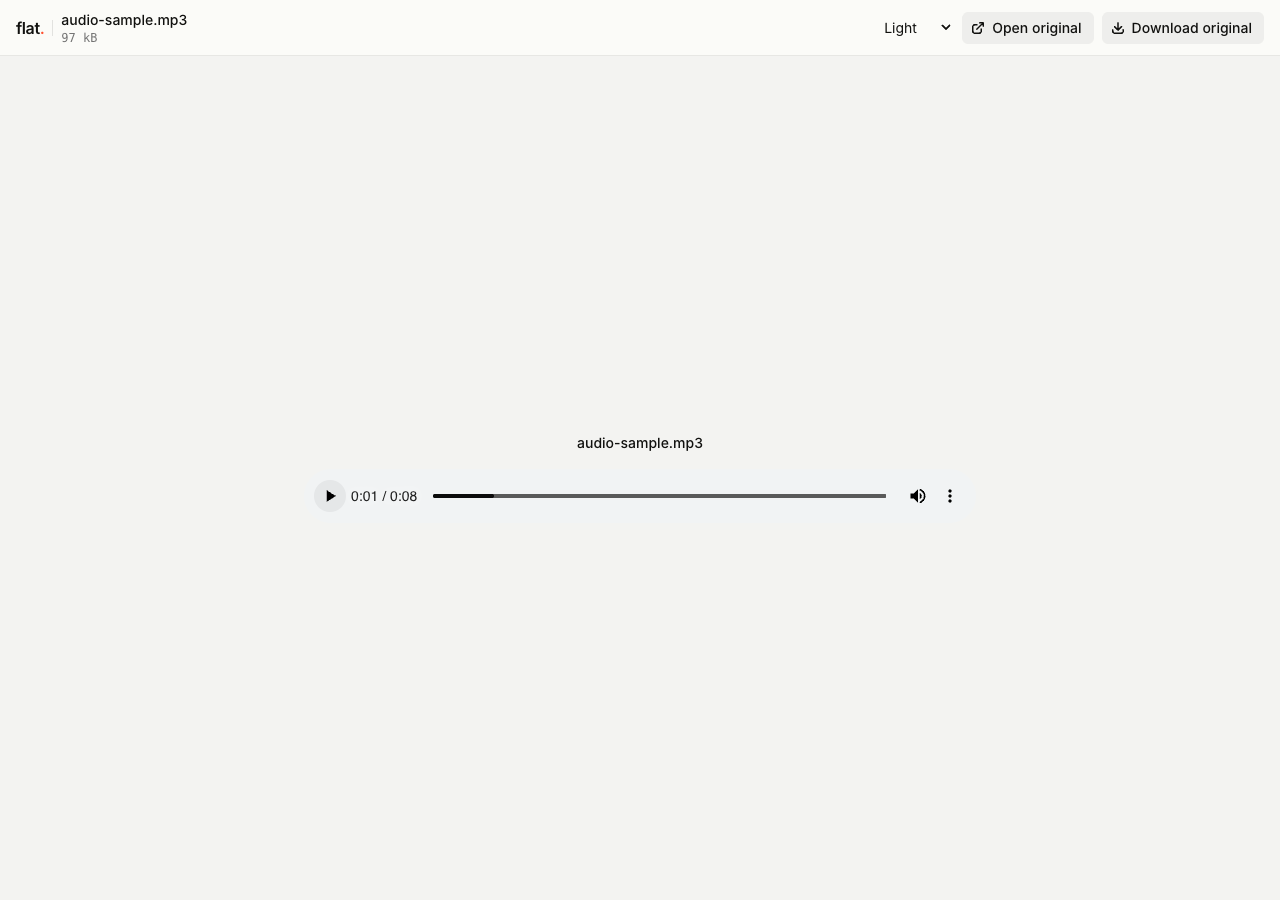
How to upload an audio file and get a link
Prepare your recording
Export the finished recording from your audio tool. MP3 is a common choice for browser listening. WAV and lossless formats can be larger; choose your file size and encoding before publishing.
Flat does not record, edit, normalize, or transcode audio. Browser playback depends on the file's codec, and the built-in viewer previews files up to 5 MiB.
Upload in your browser
Drop one or more recordings into the uploader above. Enter your email if signed out, then choose "Publish audio".
Selected files need unique names and publish at the top level. The browser uploader does not accept folders or extract ZIPs.
Deploy with the CLI
Install Node.js 20 or newer, then publish a finished audio file:
npx -y @getflat/cli deploy ./audio-sample.mp3Replace the example path with your recording. Pass a folder path to publish several tracks with their relative paths intact. The CLI prints the published URL.
Listen before sharing
Open the published link, play the recording, and check seeking and volume on the devices your listeners use. If it cannot play, export a compatible version in your own audio tool.
Signed-out uploads expire after 1 hour by default. Sign in before expiry to keep them online, or sign in before publishing for no default expiry.
What you can share with audio hosting
Voiceovers and music demos
Send a finished take or short mix to a client. Each upload has a separate version link. Collect feedback in your existing conversation or review tool.
Pronunciation and lesson clips
Give learners a link to a short recording. They can listen in the browser or download the file for use in their own player.
Interview and podcast excerpts
Publish a short excerpt for review or promotion. Flat hosts the file; podcast feeds and distribution require a separate publishing workflow.
Keep a version, or keep an address.
Share this version
Every upload gets its own link. Publishing revised files creates a new link and leaves the earlier version unchanged. Use the version link when someone needs to review a specific upload.
Update files at one address
Use a named onflat.page address or your own domain. Sign in, then publish with the CLI using --domain. Publish revised files with the same domain to point that address to the new upload.
Named addresses are included on Free. Adding your own domain requires a paid plan. The browser uploader does not set up or repoint these addresses.
Choose your audio format
Find the guide for your audio file.
Audio hosting questions
Is hosting free, and what are the limits?
Yes. Signed-in Free includes 5 MiB per upload, 1 GiB of storage, and 5 GiB of monthly transfer, with no default expiry. The per-upload limit covers all files in that upload. Paid plans raise these limits.
Do readers need a Flat account?
No. Public links open without a Flat account. Anyone with the link can open the uploaded files. Password-protected links also require the visitor password.
Can I password-protect my upload?
Yes. Password protection is available on every plan. Add --password YOUR_PASSWORD to your CLI deploy command. It protects access to the upload and its files, but does not prevent someone with access from saving a copy. The browser uploader creates public uploads.
Can I replace files without changing the link?
A version link always refers to its original upload. For same-address updates, use a named address or your own domain. Publish revised files with the same --domain value in the CLI to point that address to the new upload.
What happens when an upload expires?
Flat stops serving it. An expired upload cannot be recovered. Signed-out uploads expire after 1 hour by default. For browser uploads, use the sign-in link shown after publishing. For CLI uploads, run npx -y @getflat/cli login. Complete sign-in before expiry to keep the upload online. If you chose a shorter expiry in the CLI, that deadline stays in place.
Which audio formats does Flat recognize?
The audio viewer recognizes MP3, WAV, OGG, OGA, M4A, AAC, FLAC, and OPUS. Playback depends on the browser and the actual codec inside the file. A recognized extension does not guarantee playback.
Can I host a recording larger than 5 MiB?
Yes, if your hosting plan permits its size. Flat's built-in viewer still has a 5 MiB preview limit. Larger recordings remain available through their original URLs for download or a compatible player of your own. Paid plans do not raise the built-in preview limit.
Can I embed the audio on my website?
Use a public upload's original audio URL in an audio element:
<audio controls src="https://YOUR-ADDRESS.onflat.page/audio-sample.mp3"></audio>The generated Flat viewer cannot be embedded in an iframe. Browser autoplay restrictions still apply to your own player.
Does Flat create podcast feeds or audio transcripts?
No. Flat serves your finished audio files. It does not generate an RSS feed, submit episodes to podcast apps, or transcribe recordings.
Send a listening link to your next recording.
Publish the finished audio, check playback, and share the URL.
Publish audioFree to start · View pricing
Sharing a clip with pictures? See video hosting.