Flat / JSONC hosting
JSONC hosting: share JSON configuration with comments
Give a commented configuration file a link. Upload JSONC from your browser or the CLI and let readers inspect, copy, or download the original source.
Checking your upload limits... · Public · Limits
Drop your JSONC files here
or choose them from your device.
Select JSONC filesWhat readers see at your JSONC link
Flat highlights JSONC source, including its comments. The screenshot shows a sample project configuration with explanatory notes. Readers can wrap long lines and copy the displayed text.
The file stays JSONC. Flat does not remove comments, convert it to strict JSON, or check whether a particular application accepts its settings.
A single file opens in the viewer. Several files open in the explorer, where readers can choose a file. Public links need no Flat account. Original downloads remain available if a preview cannot load.
The main link opens Flat's viewer. The exact path /project.jsonc serves the original file, without changing its contents.
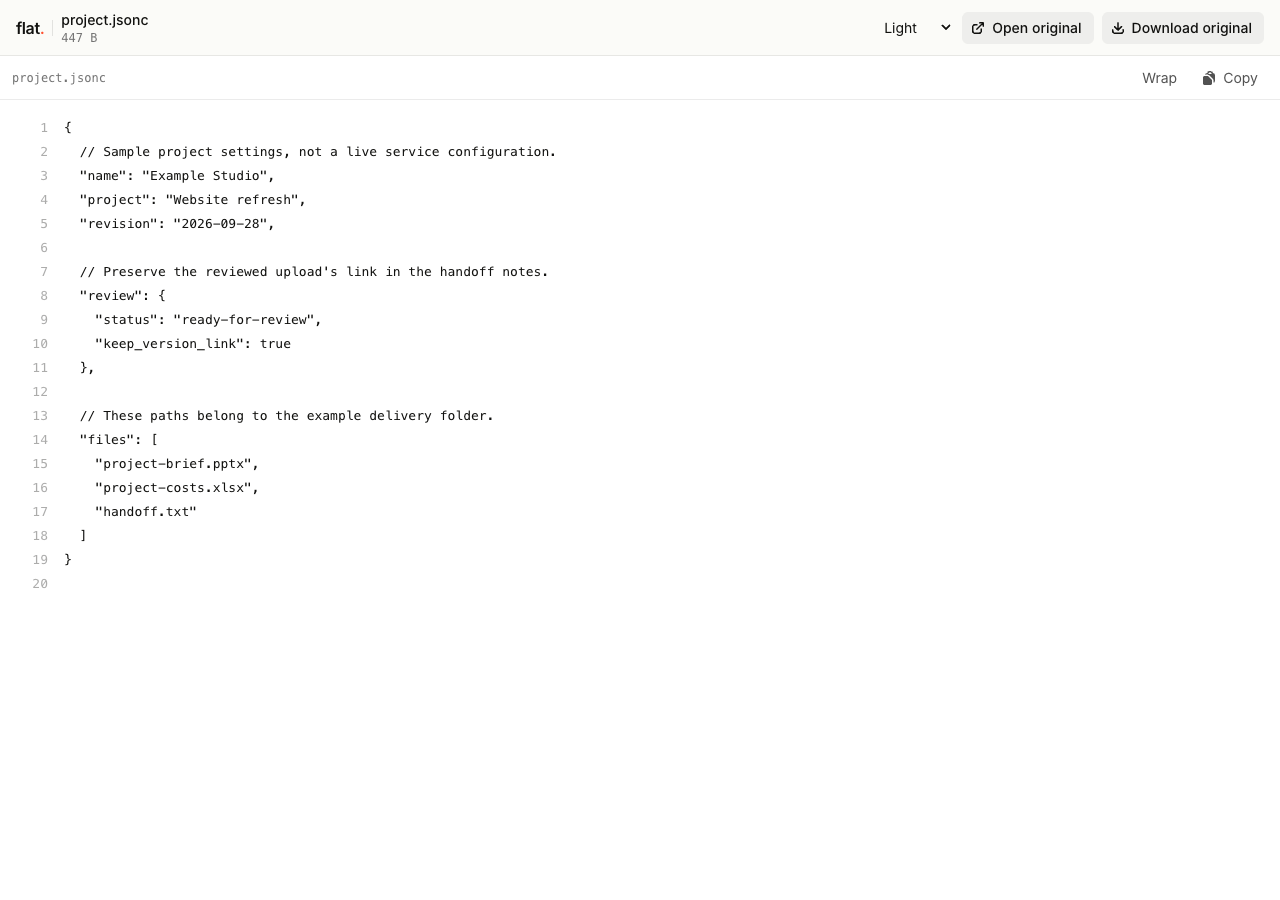
How to upload JSONC files and get a link
Prepare your file
Use comments to explain the purpose of settings and any required values. Validate the configuration with its intended application; JSONC parsers can differ in what they accept, including trailing commas.
If a consumer requires strict JSON, generate a separate JSON file before publishing. Keep filenames explicit so readers know which format they are downloading.
Publish from your browser or terminal
In your browserGo to uploaderDrop, publish, copy the link.
Drop your finished files into the uploader above, or select them from your device. Enter your email if signed out, then choose "Publish files".
Selected files need unique names and publish at the top level. Use the CLI for folders; the browser uploader does not accept folders or extract ZIPs.
TerminalNode.js 20+One command. Files or folders.
npx -y @getflat/cli deploy ./project.jsoncReplace the example path with your file. Pass a folder to publish related files with their relative paths intact. The CLI prints the published URL.
Check before sharing
Check comment visibility and long values in the preview. Download the JSONC and load it with the intended application's parser before sharing it as a working example.
Signed-out uploads expire after 1 hour by default. Sign in before expiry to keep them online, or sign in before publishing for no default expiry.
What you can share with JSONC hosting
Annotated configuration examples
Explain why settings exist directly beside their values, then give teammates the original file to adapt.
Tool setup handoffs
Share a saved editor or build-tool configuration with notes about the environment where it applies.
Keep a version, or keep an address.
Share this version
Every upload gets its own link. Publishing revised files creates a new link and leaves the earlier version unchanged. Use the version link when someone needs to review a specific upload.
Update files at one address
Use a named onflat.page address or your own domain. Sign in, then publish with the CLI using --domain. Publish revised files with the same domain to point that address to the new upload.
Named addresses are included on Free. Adding your own domain requires a paid plan. The browser uploader does not set up or repoint these addresses.
JSONC hosting questions
Is hosting free, and what are the limits?
Yes. Signed-in Free includes 5 MiB per upload, 1 GiB of storage, and 5 GiB of monthly transfer, with no default expiry. The per-upload limit covers all files in that upload. Paid plans raise these limits.
Do readers need a Flat account?
No. Public links open without a Flat account. Anyone with the link can open the uploaded files. Password-protected links also require the visitor password.
Can I password-protect my upload?
Yes. Password protection is available on every plan. Add --password YOUR_PASSWORD to your CLI deploy command. It protects access to the upload and its files, but does not prevent someone with access from saving a copy. The browser uploader creates public uploads.
Can I replace files without changing the link?
A version link always refers to its original upload. For same-address updates, use a named address or your own domain. Publish revised files with the same --domain value in the CLI to point that address to the new upload.
What happens when an upload expires?
Flat stops serving it. An expired upload cannot be recovered. Signed-out uploads expire after 1 hour by default. For browser uploads, use the sign-in link shown after publishing. For CLI uploads, run npx -y @getflat/cli login. Complete sign-in before expiry to keep the upload online. If you chose a shorter expiry in the CLI, that deadline stays in place.
Can a normal JSON parser read the original URL?
Strict JSON does not permit comments. A consumer needs JSONC support, or you must export a separate strict JSON file. Flat serves your uploaded source unchanged.
Does highlighting prove the configuration is valid?
No. Highlighting does not check allowed fields, application versions, or parser-specific rules. Validate the file with the actual tool that will read it.
How large can an upload be?
Upload allowances depend on your plan and cover all files in the upload. Compare current plan limits. Preview availability also depends on format and processing support. The original file remains available to download if a preview is unavailable.
Can I embed the viewer on another website?
Flat's generated viewer cannot be embedded in an iframe and keeps Flat branding on every plan. Link to the viewer for reading or to the exact file URL for the original.
Another text format?
Find the guide for your text file.
Give your JSONC files a link.
Publish your file, check the preview, and share the URL.
Publish filesFree to start · View pricing